
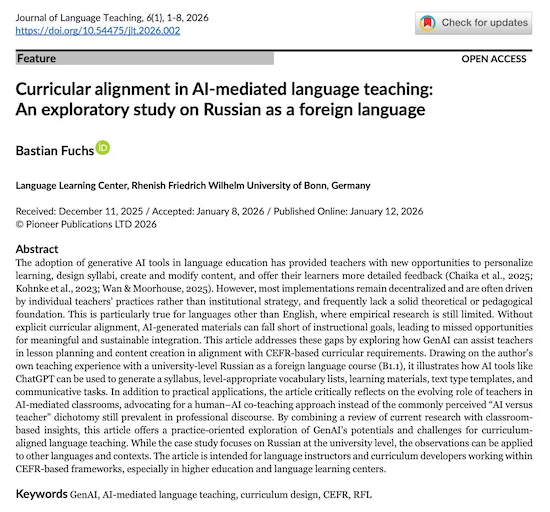
Curricular alignment in AI-mediated language teaching: An exploratory study on Russian as a foreign language
DOI:
https://doi.org/10.54475/jlt.2026.002Keywords:
GenAI, AI-mediated language teaching, curriculum design, CEFR, RFLAbstract
The adoption of generative AI tools in language education has provided teachers with new opportunities to personalize learning, design syllabi, create and modify content, and offer their learners more detailed feedback (Chaika et al., 2025; Kohnke et al., 2023; Wan & Moorhouse, 2025). However, most implementations remain decentralized and are often driven by individual teachers’ practices rather than institutional strategy, and frequently lack a solid theoretical or pedagogical foundation. This is particularly true for languages other than English, where empirical research is still limited. Without explicit curricular alignment, AI-generated materials can fall short of instructional goals, leading to missed opportunities for meaningful and sustainable integration. This article addresses these gaps by exploring how GenAI can assist teachers in lesson planning and content creation in alignment with CEFR-based curricular requirements. Drawing on the author’s own teaching experience with a university-level Russian as a foreign language course (B1.1), it illustrates how AI tools like ChatGPT can be used to generate a syllabus, level-appropriate vocabulary lists, learning materials, text type templates, and communicative tasks. In addition to practical applications, the article critically reflects on the evolving role of teachers in AI-mediated classrooms, advocating for a human–AI co-teaching approach instead of the commonly perceived “AI versus teacher” dichotomy still prevalent in professional discourse. By combining a review of current research with classroom-based insights, this article offers a practice-oriented exploration of GenAI’s potentials and challenges for curriculum-aligned language teaching. While the case study focuses on Russian at the university level, the observations can be applied to other languages and contexts. The article is intended for language instructors and curriculum developers working within CEFR-based frameworks, especially in higher education and language learning centers.
References
Akinsemolu, A. A., & Onyeaka, H. (2025). The role of Artificial Intelligence in transforming language learning: Opportunities and ethical considerations. Journal of Language and Education, 11(1), 148–152. https://doi.org/10.17323/jle.2025.22118 DOI: https://doi.org/10.17323/jle.2025.22118
Alm, A. (2025). Reconceptualising literacy as co-literacy in language education with AI. In Y. Wang, A. Alm, & G. Dizon (Eds.), Insights into AI and language teaching and learning (pp. 53–76). Castledown. DOI: https://doi.org/10.29140/9781763711600-04
Al-Mughairi, H., & Bhaskar, P. (2025). Exploring the factors affecting the adoption AI techniques in higher education: Insights from teachers’ perspectives on ChatGPT. Journal of Research in Innovative Teaching and Learning, 18(2), 232–247. https://doi.org/10.1108/JRIT-09-2023-0129 DOI: https://doi.org/10.1108/JRIT-09-2023-0129
Barrot, J. S. (2023). Using ChatGPT for second language writing: Pitfalls and potentials. Assessing Writing, 57, Article 100745. https://doi.org/10.1016/j.asw.2023.100745 DOI: https://doi.org/10.1016/j.asw.2023.100745
Chaika, O., Sharmanova, N., & Berezovska-Savchuk, N. (2025). Designing English and Ukrainian language courses with AI tools: Comparative approach. In O. Chaika (Ed.), Educational policy and reforms: The impact of globalization (pp. 5–34). Technology Center PC. https://doi.org/10.15587/978-617-8360-20-7.ch1 DOI: https://doi.org/10.15587/978-617-8360-20-7.ch1
Cogo, A., Patsko, L., & Szoke, J. (2024). Generative Artificial Intelligence and ELT. ELT Journal, 78(4), 373–377. https://doi.org/10.1093/elt/ccae051 DOI: https://doi.org/10.1093/elt/ccae051
Colpaert, J. (2025). The added value of AI for language teaching and learning. In Y. Wang, A. Alm, & G. Dizon (Eds.), Insights into AI and language teaching and learning (pp. v–ix). Castledown.
Council of Europe. (2001). Common European Framework of Reference for Languages: Learning, Teaching, Assessment. https://www.coe.int/en/web/common-european-framework-reference-languages
Crosthwaite, P., & Ma, Q. (2025). AI and language assessment. In Y. Wang, A. Alm, & G. Dizon (Eds.), Insights into AI and language teaching and learning (pp. 77–96). Castledown. DOI: https://doi.org/10.29140/9781763711600-05
Daud, A., Aulia, A. F., Muryanti, Harfal, Z., Nabilla, O., & Ali, H. S. (2025). Integrating Artificial Intelligence into English language teaching: A systematic review. European Journal of Educational Research, 14(2), 677–691. https://doi.org/10.12973/eu-jer.14.2.677 DOI: https://doi.org/10.12973/eu-jer.14.2.677
Dogan, M. E., Goru Dogan, T., Bozkurt, A. (2023). The use of Artificial Intelligence (AI) in online learning and distance education processes: A systematic review of empirical studies. Applied Sciences, 13(5), Article 3056. https://doi.org/10.3390/app13053056 DOI: https://doi.org/10.3390/app13053056
Dornicheva, D., & Birzer, S. (2023). Playing at conversation. Chatbots in Russian language teaching. In S. V. Nuss, & V. V. Kogan (Eds.), Dynamic teaching of Russian. Games and gamification of learning (pp. 190–208). Routledge. https://doi.org/10.4324/9781003369721 DOI: https://doi.org/10.4324/9781003369721-14
Du, J., & Daniel, B. K. (2024). Transforming language education: A systematic review of AI-powered chatbots for English as a foreign language speaking practice. Computers and Education: Artificial Intelligence, 6, Article 100230. https://doi.org/10.1016/j.caeai.2024.100230 DOI: https://doi.org/10.1016/j.caeai.2024.100230
Edmett, A., Ichaporia, N., Crompton, H., & Crichton, R. (2024). Artificial Intelligence and English language teaching: Preparing for the future (2nd ed.). British Council. https://doi.org/10.57884/78EA-3C69
ElSayary, A. (2023). An investigation of teachers’ perceptions of using ChatGPT as a supporting tool for teaching and learning in the digital era. Journal of Computer Assisted Learning, 40(3), 931–945. https://doi.org/10.1111/jcal.12926 DOI: https://doi.org/10.1111/jcal.12926
Fuchs, B., & Rönnau, M. (2025). Russisch lernen mit Künstlicher Intelligenz im universitären Kontext: Ein niveau-übergreifender Methodenkurs. SlavUn – Slavische Sprachen Unterrichten, Themenheft „KI-basierte Anwendungen in der Vermittlung slavischer Sprachen“, 2, 13–29. https://doi.org/10.20377/slavun-9 DOI: https://doi.org/10.20377/slavun-9
Gentile, M., Città, G., Perna, S., & Allegra, M. (2023). Do we still need teachers? Navigating the paradigm shift of the teacher’s role in the AI era. Frontiers in Education, 8, Article 1161777. https://doi.org/10.3389/feduc.2023.1161777 DOI: https://doi.org/10.3389/feduc.2023.1161777
Gupta, K. P., & Bhaskar, P. (2020). Inhibiting and motivating factors influencing teachers’ adoption of AI-based teaching and learning solutions: Prioritization using analytic hierarchy process. Journal of Information Technology Education: Research, 19, 693–723. https://doi.org/10.28945/4640 DOI: https://doi.org/10.28945/4640
Heaps, T. (2024). Generative Artificial Intelligence: Practical uses in education. Red River College Polytechnic and Campus Manitoba. https://pressbooks.openedmb.ca/aiineducation/ (04.12.2025)
Hubbard, P., & Schulze, M. (2025). AI and the future of language teaching: Motivating Sustained Integrated Professional Development. International Journal of Computer-Assisted Language Learning and Teaching, 15(1), 1–17. https://doi.org/10.4018/IJCALLT.378304 DOI: https://doi.org/10.4018/IJCALLT.378304
Hulstijn, J. H. (2014). The Common European Framework of Reference for Languages: A challenge for applied linguistics. International Journal of Applied Linguistics, 165(1), 3–18. https://doi.org/10.1075/itl.165.1.01hul DOI: https://doi.org/10.1075/itl.165.1.01hul
Isemonger, I. (2023). Generative language models in education: Foreign language learning and the teacher as prompt engineer. TEFL Praxis Journal, 2(1), 3–17. https://doi.org/10.5281/zenodo.10402411
Karataş, F., Eriçok, B., & Tanrikulu, L. (2024a). Reshaping curriculum adaptation in the age of Artificial Intelligence: Mapping teachers’ AI-driven curriculum adaptation patterns. British Educational Research Journal, 51(1), 154–180. http://doi.org/10.1002/berj.4068 DOI: https://doi.org/10.1002/berj.4068
Karataş, F., Abedi, F. Y., Ozek Gunyel, F., Karadeniz, D., & Kuzgun, Y. (2024b). Incorporating AI in foreign language education: An investigation into ChatGPT’s effect on foreign language learners. Education and Information Technologies, 29, 19343–19366. https://doi.org/10.1007/s10639-024-12574-6 DOI: https://doi.org/10.1007/s10639-024-12574-6
Kasneci, E., Sessler, K., Küchemann, S., Bannert, M., Dementieva, D., Fischer, F., Gasser, U., Groh, G., Günnemann, S., Hüllermeyer, E., Krusche, S., Kutyniok, G., Michaeli, T., Nerdel, C., Pfeffer, J., Poquet, O., Sailer, M., Schmidt, A., Seidel, T., … Kasneci, G. (2023). ChatGPT for good? On opportunities and challenges of large language models for education. Learning and Individual Differences, 103, Article 102274, 1–9. https://doi.org/10.1016/j.lindif.2023.102274 DOI: https://doi.org/10.1016/j.lindif.2023.102274
Kim, J. (2024). Leading teachers’ perspective on teacher-AI collaboration in education. Education and Information Technologies, 29, 8693–8724. https://doi.org/10.1007/s10639-023-12109-5 DOI: https://doi.org/10.1007/s10639-023-12109-5
Kim, J., Yu, S., Detrick, R., Lin, X., & Li, N. (2025). Designing AI-powered learning: Adult learners’ expectations for curriculum and human-AI interaction. Educational Technology Research and Development, 1–25. https://doi.org/10.1007/s11423-025-10549-z DOI: https://doi.org/10.1007/s11423-025-10549-z
Kohnke, L., Moorhouse, B. L., & Zou, D. (2023). ChatGPT for language teaching and learning. Regional Language Centre Journal, 54(2), 537–550. https://doi.org/10.1177/00336882231162868 DOI: https://doi.org/10.1177/00336882231162868
Kostka, I., & Toncelli, R. (2023). Exploring applications of ChatGPT to English language teaching: Opportunities, challenges, and recommendations. The Electronic Journal for English as Second Language, 27(3), 1–19. https://doi.org/10.55593/ej.27107int DOI: https://doi.org/10.55593/ej.27107int
Moundridou, M., Matzakos, N., & Doukakis, S. (2024). Generative AI tools as educators’ assistants: Designing and implementing inquiry-based lesson plans. Computers and Education: Artificial Intelligence, 7, Article 100277. https://doi.org/10.1016/j.caeai.2024.100277 DOI: https://doi.org/10.1016/j.caeai.2024.100277
Neumann, M., Rauschenberger, M., & Schön, E.-M. (2023). “We need to talk about ChatGPT”: The future of AI and higher education. 2023 IEEE/ACM 5th International Workshop on Software Engineering for the Next Generation (SEENG), 29–32. https://doi.org/10.1109/SEENG59157.2023.00010 DOI: https://doi.org/10.1109/SEENG59157.2023.00010
Octavio, M. M., González Argüello, V., & Pujolà, J.-T. (2024). ChatGPT as an AI L2 teaching support: A case study of an EFL teacher. Technology in Language Teaching and Learning, 6(1), 1–25. https://doi.org/10.29140/tltl.v6n1.1142 DOI: https://doi.org/10.29140/tltl.v6n1.1142
OpenAI. (2025). ChatGPT [Large language model]. https://chat.openai.com/
Oxford University Press. (n.d.). Apartment. In Oxford Learner’s Dictionaries. Retrieved December 9, 2025, from https://www.oxfordlearnersdictionaries.com/definition/english/apartment?q=apartment
Oxford University Press. (n.d.). Campsite. In Oxford Learner’s Dictionaries. Retrieved December 9, 2025, from https://www.oxfordlearnersdictionaries.com/definition/english/campsite?q=campsite
Oxford University Press. (n.d.). Itinerary. In Oxford Learner’s Dictionaries. Retrieved December 9, 2025, from https://www.oxfordlearnersdictionaries.com/definition/english/itinerary?q=itinerary
Pape, R., & Steinbach, A. (2025). Personalized and individualized Russian learning enabled by AI: The pilot of the Language Coach. SlavUn – Slavische Sprachen Unterrichten, Themenheft „KI-basierte Anwendungen in der Vermittlung slavischer Sprachen“, 2, 57–75. https://doi.org/10.20377/slavun-19 DOI: https://doi.org/10.20377/slavun-19
Pegrum, M. (2025). From revolution to evolution: What generative AI really means for language learning. Language Teaching, 1–17. https://doi.org/10.1017/S0261444825000151 DOI: https://doi.org/10.1017/S0261444825000151
Pribble, K. (2024). Fostering critical AI literacy in the Russian language classroom. Russian Language Journal, 74(1), 1–17. https://doi.org/10.70163/0036-0252.1399 DOI: https://doi.org/10.70163/0036-0252.1399
Richards, J. C. (2013). Curriculum approaches in language teaching: Forward, central, and backward design. Regional Language Centre Journal, 44(1), 5–33. https://doi.org/10.1177/0033688212473293 DOI: https://doi.org/10.1177/0033688212473293
Richards, J. C. (2017). Curriculum development in language teaching (2nd ed.). Cambridge University Press DOI: https://doi.org/10.1017/9781009024556
Robinson, P. (2011). Syllabus design. In M. H. Long, & C. J. Doughty (Eds.), The handbook of language teaching (pp. 294–310). Wiley-Blackwell. DOI: https://doi.org/10.1002/9781444315783.ch17
Schulze, M. (2025). ICALL and AI: Seven lessons from seventy years. In Y. Wang, A. Alm, & G. Dizon (Eds.), Insights into AI and language teaching and learning (pp. 11–31). Castledown. DOI: https://doi.org/10.29140/9781763711600-02
Stockwell, G. (2024). ChatGPT in language teaching and learning: Exploring the road we’re travelling. Technology in Language Teaching and Learning, 6(1), Article 2273. https://doi.org/10.29140/tltl.v6n1.2273 DOI: https://doi.org/10.29140/tltl.v6n1.2273
Stockwell, G. (2025). Professional development and learner training for AI. In Y. Wang, A. Alm, & G. Dizon (Eds.), Insights into AI and language teaching and learning (pp. 203–218). Castledown. DOI: https://doi.org/10.29140/9781763711600-12
Timon, S. (2023). Artificial Intelligence – Scary paradigm shift or opportunity to evolve? Journal of Language Teaching, 3(9), 1–6. https://doi.org/10.54475/jlt.2023.022 DOI: https://doi.org/10.54475/jlt.2023.022
Tolstykh, O. M., & Oshchepkova, T. (2024). Beyond ChatGPT: Roles that Artificial Intelligence tools can play in an English language classroom. Discover Artificial Intelligence, 4, Article 60. https://doi.org/10.1007/s44163-024-00158-9 DOI: https://doi.org/10.1007/s44163-024-00158-9
Tseng, Y.-C., & Lin, Y.-H. (2024). Enhancing English as a foreign language (EFL) learners’ writing with ChatGPT: A university-level course design. Electronic Journal of E-Learning, 22(2), Special Issue: Artificial Intelligence (AI) in Education, 78–97. https://doi.org/10.34190/ejel.21.5.3329 DOI: https://doi.org/10.34190/ejel.21.5.3329
Uchida, S. (2025). Generative AI and CEFR levels: Evaluating the accuracy of text generation with ChatGPT-4o through textual features. Vocabulary Learning and Instruction, 14(1), Article 2078. https://doi.org/10.29140/vli.v14n1.2078 DOI: https://doi.org/10.29140/vli.v14n1.2078
Ukwandu, E., Omisade, O., Jones, K., Thorne, S., & Castle, M. (2025). The future of teaching and learning in the context of emerging Artificial Intelligence technologies. Futures, 171, Article 103616, 1–16. https://doi.org/10.1016/j.futures.2025.103616 DOI: https://doi.org/10.1016/j.futures.2025.103616
UNESCO. (2024). AI competency framework for teachers. https://doi.org/10.54675/ZJTE2084 DOI: https://doi.org/10.54675/ZJTE2084
Wan, Y., & Moorhouse, B. L. (2025). Challenges of AI in language education. In Y. Wang, A. Alm, & G. Dizon (Eds.), Insights into AI and language teaching and learning (pp. 32–52). Castledown. DOI: https://doi.org/10.29140/9781763711600-03
Wiggins, G., & McTighe, J. (2005). Understanding by design (2nd ed.). Association for Supervision and Curriculum Development.
Wisniewski, K. (2018). The empirical validity of the Common European Framework of Reference scales. An exemplary study for the vocabulary and fluency scales in a language testing context. Applied Linguistics, 39(6), 933–959. https://doi.org/10.1093/applin/amw057 DOI: https://doi.org/10.1093/applin/amw057
Downloads
Published
Issue
Section
License
Copyright (c) 2026 Journal of Language Teaching

This work is licensed under a Creative Commons Attribution 4.0 International License.
How to Cite