
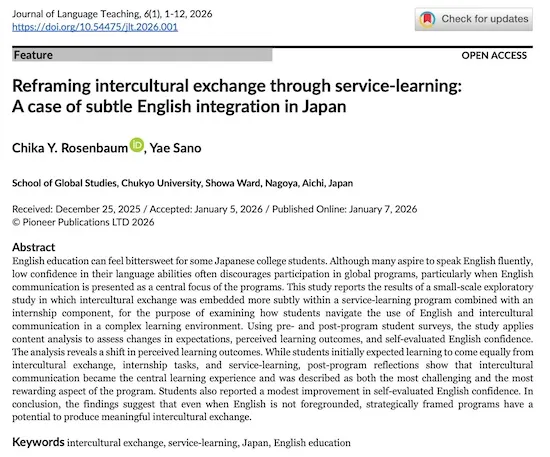
Reframing intercultural exchange through service-learning:A case of subtle English integration in Japan
DOI:
https://doi.org/10.54475/jlt.2026.001Keywords:
intercultural exchange, service-learning, Japan, English educationAbstract
English education can feel bittersweet for some Japanese college students. Although many aspire to speak English fluently, low confidence in their language abilities often discourages participation in global programs, particularly when English communication is presented as a central focus of the programs. This study reports the results of a small-scale exploratory study in which intercultural exchange was embedded more subtly within a service-learning program combined with an internship component, for the purpose of examining how students navigate the use of English and intercultural communication in a complex learning environment. Using pre- and post-program student surveys, the study applies content analysis to assess changes in expectations, perceived learning outcomes, and self-evaluated English confidence. The analysis reveals a shift in perceived learning outcomes. While students initially expected learning to come equally from intercultural exchange, internship tasks, and service-learning, post-program reflections show that intercultural communication became the central learning experience and was described as both the most challenging and the most rewarding aspect of the program. Students also reported a modest improvement in self-evaluated English confidence. In conclusion, the findings suggest that even when English is not foregrounded, strategically framed programs have a potential to produce meaningful intercultural exchange.
References
Afzal, A., & Hussain, N. (2020). Impact of community service learning on the social skills of students. Journal of Education and Educational Development, 7(1), 55–70. http://dx.doi.org/10.22555/joeed.v7i1.2988 DOI: https://doi.org/10.22555/joeed.v7i1.2988
Allen, T. J., & Ramonda, K. (2023). Study abroad during a pandemic: The impact of remote learning and social distancing on student experiences. Journal of Foreign Language Studies, 28, 93–108.
Astin, A. W., Vogelgesang, L. J., Ikeda, E. K., & Yee, J. A. (2000). How service learning affects students (Higher Education Research Institute Report No. 144). University of California, Los Angeles.
Burden, P. (2020). Do Japanese university students want to study abroad? The Language Teacher, 44(2), 3–11. DOI: https://doi.org/10.37546/JALTTLT44.2-1
Celio, C. I., Durlak, J. A., & Dymnicki, A. B. (2011). A meta-analysis of the impact of service-learning on students. Journal of Experiential Education, 34(2), 164–181. https://doi.org/10.1177/105382591103400205 DOI: https://doi.org/10.5193/JEE34.2.164
Chang, S., & Gomes, C. (2022). Why the digitalization of international education matters. Journal of Studies in International Education, 26(2), 119–127. https://doi.org/10.1177/10283153221095163 DOI: https://doi.org/10.1177/10283153221095163
Clark, C., Faircloth, C. V., Lasher, R., & McDonald, M. K. (2013). Alternative spring break Jamaica! Service learning and civic engagement in a developing country. Global Partners in Education Journal, 3(1), 49–56.
Di Pietro, G. (2022). Does an international academic environment promote study abroad? Journal of Studies in International Education, 26(1), 3–20. https://doi.org/10.1177/1028315320913260 DOI: https://doi.org/10.1177/1028315320913260
Dong, Y., & Ishige, A. (2022). Studying abroad from home: An exploration of international graduate students’ perceptions and experiences of emergency remote teaching. Education Sciences, 12(2), 98. https://doi.org/10.3390/educsci12020098 DOI: https://doi.org/10.3390/educsci12020098
Gaitanidis, L. (2021). Studying abroad at home: The meaning of education abroad during the pandemic. PORTAL Journal of Multidisciplinary International Studies, 17(1–2), 67–72. https://doi.org/10.5130/pjmis.v17i1-2.7409 DOI: https://doi.org/10.5130/pjmis.v17i1-2.7409
Gallini, S. M., & Moely, B. E. (2003). Service-learning and engagement, academic challenge, and retention. Michigan Journal of Community Service Learning, 10(1), 5–14.
Hamada, I., & Iwasaki, S. (2024). Assessing benefits: A comparative evaluation of English–Japanese online intercultural exchanges (OIE) before and during the COVID-19 pandemic. The Language Learning Journal, 52(5), 487–505. https://doi.org/10.1080/09571736.2024.2369920 DOI: https://doi.org/10.1080/09571736.2024.2369920
Iwaki, N., & Tatsumi, Y. (2021). How has COVID-19 changed students’ perspectives on study abroad? From students’ survey results. Nagoya Journal of Higher Education, 21, 187–206.
Iwata, K. (2016). A study of preparation for service learning: Practical aims for the Division of Career Development. Bulletin of Nakamura Gakuen University and Nakamura Gakuen University Junior College, 48, 241–246.
Kawata, T. (2014). 大学教育におけるサービスラーニング導入の可能性について [On the potential for introducing service-learning in university education]. 聖学院大学総合研究所 Newsletter, 23(3), 17–25. [In Japanese].
Katsumata, E. (2021). Intercultural exchange between Japanese EFL students and international students. The Aoyama Journal of International Politics, Economics and Communication, 107, 63–80.
Kavanagh, B. (2006). The Input Hypothesis (Krashen, 1982, 1985): An evaluation of its contributions to our understanding of second language acquisition phenomena. Journal of Aomori University of Health and Welfare, 7(2), 241–248.
Kim, H. S., & Lawrence, J. H. (2021). Who studies abroad? Understanding the impact of intent on participation. Research in Higher Education, 62, 1039–1085. https://doi.org/10.1007/s11162-021-09629-9 DOI: https://doi.org/10.1007/s11162-021-09629-9
Kobayashi, W., Jūdai, T., Kitahara, T., Kanda, T., Ishioka, T., & Kō, E. (2021). 外国語で行う授業に関する教授法開発―学際的アプローチを通して [Development of teaching methods for courses taught in a foreign language: An interdisciplinary approach]. Nihon University College of Humanities and Sciences Departmental Bulletin Paper, 102, 129–147. [In Japanese].
Kojima, N., Uchino, T., Isobe, N., Tanaka, J., Nihonmatsu, M., Okamoto, Y., Miyake, Y., Jinnin, R., Yashiki, H., & Yoshihara, M. (2015). Inward-oriented Japanese students and international exchange. Bulletin of General Health Research, Hiroshima University Health Service Center, 31, 35–42.
Kurita, S. (2021). The importance and challenges of international education under COVID-19 from the practice of “International Exchange Days 2020, Connecting with the World through Online”. Bulletin of Center for International Education and Research, Mie University, 16(23), 159–176.
Lau, K. H., Chan, M. Y. L., Yeung, C. L. S., & Snell, R. S. (2021). An exploratory study of the community impacts of service-learning. Metropolitan Universities, 32(2), 106–128. https://doi.org/10.18060/25482 DOI: https://doi.org/10.18060/25482
Luo, J., & Jamieson-Drake, D. (2013). Examining the educational benefits of interacting with international students. Journal of International Students, 3(2), 85–101. https://doi.org/10.32674/jis.v3i2.503 DOI: https://doi.org/10.32674/jis.v3i2.503
Matikainen, T., & Cote, T. (2021). Studying ‘abroad’ online: Reflections from a Japanese university. The Journal of Tamagawa University College of Tourism and Hospitality, 9, 81–87.
Minotti, T. (2022). Comparing an online to an on-site study abroad program. Asian Journal of Research in Education and Social Sciences, 4(4), 1–6.
Mishra, A. (2022, June 27–28). Virtual study abroad in the post-pandemic world [Paper presentation]. Seventh International Conference on Tourism & Leisure Studies, Muziris Research and Convention Center, Pullut, Thrissur, Kerala, India.
Merola, R. H., Coelen, R. J., Hofman, W. H. A., & Jansen, E. P. W. A. (2023). Through the looking glass: How the COVID-19 pandemic changed international branch campuses’ academic experience and home campus relationship. Journal of Studies in International Education, 27(1), 3–20. https://doi.org/10.1177/10283153211070112 DOI: https://doi.org/10.1177/10283153211070112
Nakahashi, M. (2022). Implementation and challenges of online international exchange under the COVID-19 pandemic. Journal of the Japan Association for Global Competency Education, 10(1), 47–59.
Ngai, G., Chan, S. C. F., & Kwan, K. (2018). Challenge, meaning, interest, and preparation: Critical success factors influencing student learning outcomes from service-learning. Journal of Higher Education Outreach and Engagement, 22(4), 55–80.
Rosenbaum, C., Yamamoto, I., Iwaki, N., & Tatsumi, Y. (2025). Rethinking study abroad: Post-pandemic perspectives on international exchange in Japan. Cogent Education, 12(1). https://doi.org/10.1080/2331186X.2024.2437875 DOI: https://doi.org/10.1080/2331186X.2024.2437875
Rosenbaum, C. (2024). When English education isn't what it seems: Outcomes from a pilot study in Japan. Journal of Language Teaching, 3(4), 11–16. DOI: https://doi.org/10.54475/jlt.2024.016
Santiso, G. B., & Sanz, C. (2022). Study abroad and student decision making in times of COVID: A mixed methods study. Frontiers: The Interdisciplinary Journal of Study Abroad, 34(1), 45–60. https://doi.org/10.36366/frontiers.v34i1.649 DOI: https://doi.org/10.36366/frontiers.v34i1.649
Shabani, K., Khatib, M., & Ebadi, S. (2010). Vygotsky's zone of proximal development: Instructional implications and teachers' professional development. English Language Teaching, 3(4), 237–248. https://doi.org/10.5539/elt.v3n4p237 DOI: https://doi.org/10.5539/elt.v3n4p237
Sponseller, A. C. (2021). Examining motivation to study abroad among Japanese undergraduates. Journal of Osaka Jogakuin College, 51, 255–279.
Tatsumi, Y. (2025). Development and implementation of short term study abroad programs based on intercultural collaborative learning. Annual Report of the Global Engagement Center, Nagoya University, 2, 57–66.
Upson, J. W., & Bergiel, E. B. (2023). Virtual study abroad: Is there life after the pandemic? Journal of International Education in Business, 16(1), 37–55. https://doi.org/10.1108/JIEB-01-2022-0004 DOI: https://doi.org/10.1108/JIEB-01-2022-0004
Downloads
Published
Issue
Section
License
Copyright (c) 2026 Journal of Language Teaching

This work is licensed under a Creative Commons Attribution 4.0 International License.
How to Cite