
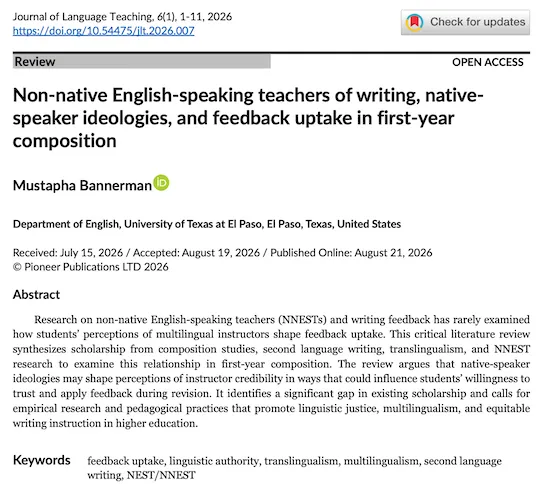
Non-native English-speaking teachers of writing, native-speaker ideologies, and feedback uptake in first-year composition
DOI:
https://doi.org/10.54475/jlt.2026.007Keywords:
feedback uptake, linguistic authority, translingualism, multilingualism, second language writing, NEST/NNESTAbstract
Research on non-native English-speaking teachers (NNESTs) and writing feedback has rarely examined how students’ perceptions of multilingual instructors shape feedback uptake. This critical literature review synthesizes scholarship from composition studies, second language writing, translingualism, and NNEST research to examine this relationship in first-year composition. The review argues that native-speaker ideologies may shape perceptions of instructor credibility in ways that could influence students’ willingness to trust and apply feedback during revision. It identifies a significant gap in existing scholarship and calls for empirical research and pedagogical practices that promote linguistic justice, multilingualism, and equitable writing instruction in higher education.
References
Al Seweed, M. A. (2012). University students’ perceptions of the influence of native and non-native teachers. English Language Teaching, 5(12), 42–53. https://doi.org/10.5539/elt.v5n12p42 DOI: https://doi.org/10.5539/elt.v5n12p42
Anson, C. M. (1989). Response styles and ways of knowing. In C. M. Anson (Ed.), Writing and response: Theory, practice, and research (pp. 332–355). National Council of Teachers of English.
Ashwell, T. (2000). Patterns of teacher response to student writing in a multiple-draft composition classroom: Is content feedback followed by form feedback the best method? Journal of Second Language Writing, 9(3), 227–257. https://doi.org/10.1016/S1060-3743(00)00027-8 DOI: https://doi.org/10.1016/S1060-3743(00)00027-8
Aslan, E., & Thompson, A. S. (2017). Are they really “two different species?” Implicitly elicited student perceptions about NESTs and NNESTs. TESOL Journal, 8(2), 277–296. https://doi.org/10.1002/tesj.268 DOI: https://doi.org/10.1002/tesj.268
Beach, R. (1979). The effects of between-draft teacher evaluation versus student self-evaluation on high school students’ revising of rough drafts. Research in the Teaching of English, 13(2), 111–119. https://doi.org/10.58680/rte197917848 DOI: https://doi.org/10.58680/rte197917848
Boecher, Y. (2005). Native and nonnative English-speaking teacher distinctions: From dichotomy to collaboration. The CATESOL Journal, 17(1), 67–75. https://doi.org/10.5070/B5.36341 DOI: https://doi.org/10.5070/B5.36341
Bou Ayash, N. (2019). Toward translingual realities in composition: (Re)working local language representations and practices. Utah State University Press. https://doi.org/10.7330/9781607329046 DOI: https://doi.org/10.7330/9781607329046
Brandmo, C., & Gamlem, S. M. (2025). Students’ perceptions and outcome of teacher feedback: a systematic review. Frontiers in Education (Lausanne), 10, Article 1572950. https://doi.org/10.3389/feduc.2025.1572950 DOI: https://doi.org/10.3389/feduc.2025.1572950
Braine, G. (2005). A history of research on non-native speaker English teachers. In E. Llurda (Ed.), Non-native language teachers: Perceptions, challenges, and contributions to the profession (pp. 13–23). Springer. https://doi.org/10.1007/0-387-24565-0_2 DOI: https://doi.org/10.1007/0-387-24565-0_2
Çakir, H., & Demir, Y. (2013). A comparative analysis between NESTs and NNESTs based on perceptions of students in preparation classes. The International Journal of Social Sciences, 14(1), 36-47.
Canagarajah, A. S. (2013). Interrogating the “native speaker fallacy”: Non-linguistic roots, non-pedagogical results. In G. Braine (Ed.), Non-native educators in English language teaching (pp. 77–92). Routledge.
Chandler, J. (2003). The efficacy of various kinds of error feedback for improvement in the accuracy and fluency of L2 student writing. Journal of Second Language Writing, 12(3), 267–296. https://doi.org/10.1016/S1060-3743(03)00038-9 DOI: https://doi.org/10.1016/S1060-3743(03)00038-9
Chomsky, N. (1965). Aspects of the theory of syntax. MIT Press. DOI: https://doi.org/10.21236/AD0616323
Conference on College Composition and Communication. (1974). Students’ right to their own language. National Council of Teachers of English. https://cdn.ncte.org/nctefiles/groups/cccc/newsrtol.pdf
Conference on College Composition and Communication. (2015). CCCC guideline on national language policy. National Council of Teachers of English. https://cccc.ncte.org/cccc/resources/positions/nationallangpolicy
Conference on College Composition and Communication. (2020). CCCC statement on second language writing and multilingual writers. National Council of Teachers of English. https://cccc.ncte.org/cccc/resources/positions/secondlangwriting
Conference on College Composition and Communication. (2021). Statement on white language supremacy. National Council of Teachers of English. https://cccc.ncte.org/cccc/white-language-supremacy
Connors, R. J., & Lunsford, A. A. (1993). Teachers’ rhetorical comments on student papers. College Composition and Communication, 44(2), 200–223. https://doi.org/10.2307/358839 DOI: https://doi.org/10.58680/ccc19938835
Davies, A. (2004). The native speaker in applied linguistics. In C. Elder & A. Davies (Eds.), The handbook of applied linguistics (pp. 431–450). Blackwell Publishing Ltd. https://doi.org/10.1002/9780470757000.ch17 DOI: https://doi.org/10.1002/9780470757000.ch17
Ellis, R. (1998). Teaching and research: Options in grammar teaching. TESOL Quarterly, 32(1), 39–60. https://doi.org/10.2307/3587901 DOI: https://doi.org/10.2307/3587901
Ferris, D., & Roberts, B. (2001). Error feedback in L2 writing classes: How explicit does it need to be? Journal of Second Language Writing, 10(3), 161–184. https://doi.org/10.1016/S1060-3743(01)00039-X DOI: https://doi.org/10.1016/S1060-3743(01)00039-X
Fithriani, R. (2018). Discrimination behind NEST and NNEST dichotomy in ELT professionalism. KnE Social Sciences, 3(4), 741–755. https://doi.org/10.18502/kss.v3i4.1982 DOI: https://doi.org/10.18502/kss.v3i4.1982
Freire, P. (2014). Pedagogy of the oppressed (M. B. Ramos, Trans.; 30th anniversary ed.). Bloomsbury.
Gonzalez, R. D., & Melis, I. (2000). Language ideologies: critical perspectives on the official English movement. National Council of Teachers of English.
Horner, B., Lu, M.-Z., Royster, J. J., & Trimbur, J. (2011). Opinion: Language difference in writing: Toward a translingual approach. College English, 73(3), 303–321. https://doi.org/10.58680/ce201113403 DOI: https://doi.org/10.58680/ce201113403
Hyland, K., & Hyland, F. (2019). Contexts and issues in feedback on L2 writing. In K. Hyland & F. Hyland (Eds.), Feedback in second language writing: Contexts and issues (pp. 1–22). Cambridge University Press. https://doi.org/10.1017/9781108635547.003 DOI: https://doi.org/10.1017/9781108635547.003
Jordan, J. (2012). Redesigning composition for multilingual realities. National Council of Teachers of English.
Kachru, B. B. (1990). World Englishes and applied linguistics. World Englishes, 9(1), 3-20. https://doi.org/10.1111/j.1467-971X.1990.tb00683.x DOI: https://doi.org/10.1111/j.1467-971X.1990.tb00683.x
Karamcheti, I. (1993). Caliban in the classroom. Radical Teacher, (44), 13–17.
Khor, S. Y., Sánchez-Martín, C., Seloni, L., Rahman, M. M., & Yigitbilek, D. (2024). Multilingual writing teacher identities and institutional ecologies: A collaborative narrative inquiry. In M. Tseptsura & T. Ruecker (Eds.), Nonnative English-speaking teachers of U.S. college composition: Exploring identities and negotiating difference (pp. 45–66). WAC Clearinghouse and University Press of Colorado. https://doi.org/10.37514/INT-B.2024.2142.2.03 DOI: https://doi.org/10.37514/INT-B.2024.2142.2.03
Lee, G., & Schallert, D. L. (2008). Meeting in the margins: Effects of the teacher–student relationship on revision processes of EFL college students taking a composition course. Journal of Second Language Writing, 17(3), 165–182. https://doi.org/10.1016/j.jslw.2007.11.002 DOI: https://doi.org/10.1016/j.jslw.2007.11.002
Mahboob, A. (2004). Native or non-native: What do the students think. In L. D. Kamhi-Stein (Ed.), Learning and teaching from experience: Perspectives on nonnative English-speaking professionals (pp. 121–147). University of Michigan Press.
Matsuda, A. (2006). Negotiating ELT assumptions in EIL classrooms. In A. Curtis & M. Romney (Eds.), Re-locating TESOL in an age of empire (pp. 158–170). Palgrave Macmillan.
Matsuda, P. K. (1999). Composition studies and ESL writing: A disciplinary division of labor. College Composition & Communication, 50(4), 699-721. https://doi.org/10.58680/ccc19991355 DOI: https://doi.org/10.58680/ccc19991355
Matsuda, P. K. (2006). The myth of linguistic homogeneity in US college composition. College English, 68(6), 637-651. https://doi.org/10.58680/ce20065042 DOI: https://doi.org/10.58680/ce20065042
Medgyes, P. (1992). Native or non-native: who’s worth more? ELT Journal, 46(4), 340–349. https://doi.org/10.1093/elt/46.4.340 DOI: https://doi.org/10.1093/elt/46.4.340
Moussu, L. (2018). Shortcomings of NESTs and NNESTs. In J. I. Liontas (Ed.), The TESOL encyclopedia of English language teaching (pp. 1–6). Wiley Blackwell. https://doi.org/10.1002/9781118784235.eelt0583 DOI: https://doi.org/10.1002/9781118784235.eelt0044
Paikeday, T. M. (1985). May I kill the native speaker? TESOL Quarterly, 19(2), 390–395. https://doi.org/10.2307/3586840 DOI: https://doi.org/10.2307/3586840
Park, S., & Shin, S. J. (2010). She immediately understood what I was trying to say: Student perceptions of NNESTs as writing tutors. The WATESOL NNEST Caucus Annual Review, 1, 100–118.
Pearson, W. S. (2022). A typology of the characteristics of teachers’ written feedback comments on second language writing. Cogent Education, 9(1), Article 2024937. https://doi.org/10.1080/2331186X.2021.2024937 DOI: https://doi.org/10.1080/2331186X.2021.2024937
Phillipson, R. (1992). Linguistic imperialism. Oxford University Press.
Rezvani, R., & Miri, P. (2021). The impact of gender, nativeness, and subject matter on English as a second language university students’ perception of instructor credibility and engagement: A qualitative study. Frontiers in Psychology, 12, 702250. https://doi.org/10.3389/fpsyg.2021.702250 DOI: https://doi.org/10.3389/fpsyg.2021.702250
Rudolph, N. (2018). Idealized nativeness, privilege, and marginalization in English language teaching. In J. I. Liontas (Ed.), The TESOL encyclopedia of English language teaching (pp. 1-7). Wiley. https://doi.org/10.1002/9781118784235.eelt0004 DOI: https://doi.org/10.1002/9781118784235.eelt0004
Ruecker, T., Frazier, S., & Tseptsura, M. (2018). “Language difference can be an asset”: Exploring the experiences of nonnative English speaking teachers of writing. College Composition and Communication, 69(4), 612–641. https://doi.org/10.58680/ccc201829694 DOI: https://doi.org/10.58680/ccc201829694
Ruecker, T., & Ives, L. (2015). White native English speakers needed: The rhetorical construction of privilege in online teacher recruitment spaces. TESOL Quarterly, 49(4), 733–756. https://doi.org/10.1002/tesq.195 DOI: https://doi.org/10.1002/tesq.195
Selvi, A. F., Yazan, B., & Mahboob, A. (2024). Research on “native” and “non-native” English-speaking teachers: Past developments, current status, and future directions. Language Teaching, 57(1), 1–41. https://doi.org/10.1017/S0261444823000137 DOI: https://doi.org/10.1017/S0261444823000137
Sommers, N. (1982). Responding to student writing. College Composition and Communication, 33(2), 148–156. https://doi.org/10.2307/357622 DOI: https://doi.org/10.58680/ccc198215854
Song, K. H., & Gonzalez Del Castillo, A. (2015). NNESTs’ professional identity in linguistically and culturally diverse classrooms. International Journal of Educational Psychology, 4(1), 54–83. https://doi.org/10.4471/ijep.2015.03 DOI: https://doi.org/10.4471/ijep.2015.03
TESOL International Association. (2006, March). Position statement against discrimination of nonnative speakers of English in the field of TESOL. https://www.tesol.org/media/d2gfeisk/position-statement-against-nnest-discrimination-march-2006-1.pdf.
Trimbur, J. (2008). The Dartmouth Conference and the geohistory of the native speaker. College English, 71(2), 142–169. https://doi.org/10.58680/ce20086745 DOI: https://doi.org/10.58680/ce20086745
Tseptsura, M. (2024). Cultural adaptation and building authority as NNES: A reflective study. In M. Tseptsura & T. Ruecker (Eds.), Nonnative English-speaking teachers of U.S. college composition: Exploring identities and negotiating difference (pp. 79–94). WAC Clearinghouse and University Press of Colorado. https://doi.org/10.37514/INT-B.2024.2142.2.05 DOI: https://doi.org/10.37514/INT-B.2024.2142.2.05
Tseptsura, M., & Ruecker, T. (2024). Introduction. In M. Tseptsura & T. Ruecker (Eds.), Nonnative English-speaking teachers of U.S. college composition: Exploring identities and negotiating difference (pp. 3-22). University Press of Colorado; The WAC Clearinghouse. https://doi.org/10.37514/INT-B.2024.2142.2.01 DOI: https://doi.org/10.37514/INT-B.2024.2142.2.01
Tsou, S. Y., & Chen, Y. (2019). Taiwanese university students’ perceptions toward native and non-native English-speaking teachers in EFL contexts. International Journal of Teaching and Learning in Higher Education, 31(2), 176–183.
Voeun, R., Surasin, J., & Prabjandee, D. (2020). A comparative study of student engagement in English classrooms taught by native and non-native English-speaking teachers, Koh Kong Province, Kingdom of Cambodia. HRD Journal, 11(1), 22–35.
Walkinshaw, I., & Oanh, D. H. (2014). Native and non-native English language teachers: Student perceptions in Vietnam and Japan. SAGE Open, 4(2). https://doi.org/10.1177/2158244014534451 DOI: https://doi.org/10.1177/2158244014534451
Wang-Hiles, L. (2024). Native English-speaking students' perceptions of a nonnative English-speaking writing teacher, teaching effectiveness, and language performance. In M. Tseptsura & T. Ruecker (Eds.), Nonnative English-speaking teachers of U.S. college composition: Exploring identities and negotiating difference (pp. 115–135). WAC Clearinghouse; University Press of Colorado. https://doi.org/10.37514/INT-B.2024.2142.2.07 DOI: https://doi.org/10.37514/INT-B.2024.2142.2.07
Winstone, N. E., Nash, R. A., Parker, M., & Rowntree, J. (2017). Supporting learners’ agentic engagement with feedback: A systematic review and a taxonomy of recipience processes. Educational Psychologist, 52(1), 17–37. https://doi.org/10.1080/00461520.2016.1207538 DOI: https://doi.org/10.1080/00461520.2016.1207538
Zheng, X. (2017). Translingual identity as pedagogy: International teaching assistants of English in college composition classrooms. The Modern Language Journal, 101(S1), 29–44. https://doi.org/10.1111/modl.12373 DOI: https://doi.org/10.1111/modl.12373
Zheng, X. (2025). Non-native English-speaking teachers revisited: Paradoxes in multilingual professionals’ identity development. Routledge. https://doi.org/10.4324/9781003491699 DOI: https://doi.org/10.4324/9781003491699
Downloads
Published
Issue
Section
License
Copyright (c) 2026 Journal of Language Teaching

This work is licensed under a Creative Commons Attribution 4.0 International License.
How to Cite