
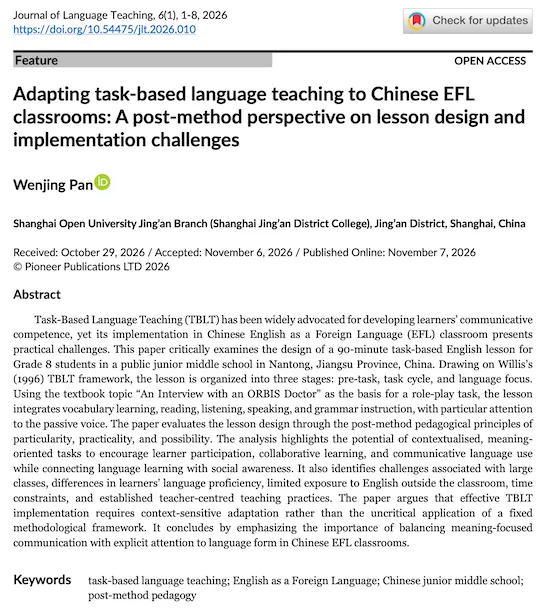
Adapting task-based language teaching to Chinese EFL classrooms: A post-method perspective on lesson design and implementation challenges
DOI:
https://doi.org/10.54475/jlt.2026.010Keywords:
task-based language teaching, TBLT, English as a Foreign Language, EFL, Chinese junior middle school, post-method pedagogyAbstract
Task-Based Language Teaching (TBLT) has been widely advocated for developing learners’ communicative competence, yet its implementation in Chinese English as a Foreign Language (EFL) classroom presents practical challenges. This paper critically examines the design of a 90-minute task-based English lesson for Grade 8 students in a public junior middle school in Nantong, Jiangsu Province, China. Drawing on Willis’s (1996) TBLT framework, the lesson is organized into three stages: pre-task, task cycle, and language focus. Using the textbook topic “An Interview with an ORBIS Doctor” as the basis for a role-play task, the lesson integrates vocabulary learning, reading, listening, speaking, and grammar instruction, with particular attention to the passive voice. The paper evaluates the lesson design through the post-method pedagogical principles of particularity, practicality, and possibility. The analysis highlights the potential of contextualised, meaning-oriented tasks to encourage learner participation, collaborative learning, and communicative language use while connecting language learning with social awareness. It also identifies challenges associated with large classes, differences in learners’ language proficiency, limited exposure to English outside the classroom, time constraints, and established teacher-centred teaching practices. The paper argues that effective TBLT implementation requires context-sensitive adaptation rather than the uncritical application of a fixed methodological framework. It concludes by emphasizing the importance of balancing meaning-focused communication with explicit attention to language form in Chinese EFL classrooms.
References
Bui, G., & Tai, K. W. H. (2022). Revisiting functional adequacy and task-based language teaching in the GBA: Insights from translanguaging. Asian-Pacific Journal of Second and Foreign Language Education, 7(1), Article 40. https://doi.org/10.1186/s40862-022-00160-7 DOI: https://doi.org/10.1186/s40862-022-00160-7
Butler, Y. G. (2011). The Implementation of Communicative and Task-Based Language Teaching in the Asia-Pacific Region. Annual Review of Applied Linguistics, 31, 36–57. https://doi.org/10.1017/s0267190511000122 DOI: https://doi.org/10.1017/S0267190511000122
Chen, Q., & Wright, C. (2016). Contextualization and authenticity in TBLT: Voices from Chinese classrooms. Language Teaching Research, 21(4), 517–538. https://doi.org/10.1177/1362168816639985 DOI: https://doi.org/10.1177/1362168816639985
Ellis, R. (2003). Task-based language learning and teaching. Oxford University Press. DOI: https://doi.org/10.65961/AJELT-2003-1-009
Ellis, R. (2009). Task-based language teaching: sorting out the misunderstandings. International Journal of Applied Linguistics, 19(3), 221–246. https://doi.org/10.1111/j.1473-4192.2009.00231.x DOI: https://doi.org/10.1111/j.1473-4192.2009.00231.x
Emirbayer, M., & Mische, A. (1998). What Is Agency? American Journal of Sociology, 103(4), 962–1023. https://doi.org/10.1086/231294 DOI: https://doi.org/10.1086/231294
Fujita, T., & Shintani, N. (2025). Evaluating a task-based language teaching course for low-proficiency learners in ESP classrooms in Japan. Language Teaching Research. https://doi.org/10.1177/13621688251324376 DOI: https://doi.org/10.1177/13621688251324376
García, O., & Li, W. (2014). Translanguaging: language, bilingualism and education. Palgrave Macmillan. DOI: https://doi.org/10.1057/9781137385765_4
Ji, Y., & Pham, T. (2020). Implementing task-based language teaching (TBLT) to teach grammar in English classes in China: using design-based research to explore challenges and strategies. Innovation in Language Learning and Teaching, 14(2), 164–177. https://doi.org/10.1080/17501229.2018.1545021 DOI: https://doi.org/10.1080/17501229.2018.1545021
Kessler, M., Solheim, I., & Zhao, M. (2021). Can task‐based language teaching be “authentic” in foreign language contexts? Exploring the case of China. TESOL Journal, 12(1), Article e534. https://doi.org/10.1002/tesj.534 DOI: https://doi.org/10.1002/tesj.534
Kumaravadivelu, B. (1994). The Postmethod Condition: Emerging Strategies for Second/Foreign Language Teaching. TESOL Quarterly, 28(1), 27–48. https://doi.org/10.2307/3587197 DOI: https://doi.org/10.2307/3587197
Kumaravadivelu, B. (2001). Toward a Postmethod Pedagogy. TESOL Quarterly, 35(4), 537-560. https://doi.org/10.2307/3588427 DOI: https://doi.org/10.2307/3588427
Kumaravadivelu, B. (2006). Understanding language teaching: From method to postmethod. Lawrence Erlbaum Associates. DOI: https://doi.org/10.4324/9781410615725
Liu, C., & Guo, R. (2020). A Study of Localization of Task-Based Language Teaching in China. Chinese Journal of Applied Linguistics, 43(2), 205–218. https://doi.org/10.1515/cjal-2020-0013 DOI: https://doi.org/10.1515/CJAL-2020-0013
Lu, J., Ma, Q., & Gao, X. (2026). Adapting TBLT in Chinese secondary schools. ELT Journal. https://doi.org/10.1093/elt/ccag029 DOI: https://doi.org/10.1093/elt/ccag029
Lu, J., Ma, Q., & Li, S. (2025). Effect of localized task‐based language teaching on Chinese secondary school English learners’ oral production in examination‐oriented contexts. International Journal of Applied Linguistics, 35(1), 168–192. https://doi.org/10.1111/ijal.12608 DOI: https://doi.org/10.1111/ijal.12608
Mao, Z. (2012). The Application of Task-based Language Teaching to English Reading Classroom. Theory and Practice in Language Studies, 2(11), 2430-2438. https://doi.org/10.4304/tpls.2.11.2430-2438 DOI: https://doi.org/10.4304/tpls.2.11.2430-2438
Mercer, S., MacIntyre, P., Gregersen, T., & Talbot, K. (2018). Positive Language Education: Combining Positive Education and Language Education. Theory and Practice of Second Language Acquisition, 4(2), Article 2. https://journals.us.edu.pl/index.php/TAPSLA/article/view/7011 DOI: https://doi.org/10.31261/TAPSLA.7011
Ministry of Education. (2022, April 8). National English Curriculum Standards. http://www.moe.gov.cn/srcsite/A26/s8001/202204/t20220420_619921.html
Morrow, K. (1977). Authentic texts and ESP. In S. Holden (Ed.), English for Specific Purposes (pp. 13–17). Modern English Publications.
Nunan, D. (1989). Designing tasks for the communicative classroom. Cambridge University Press.
Prabhu, N. S. (1987). Second Language Pedagogy (1st edition). Oxford University Press.
Swan, M. (2005). Legislation by Hypothesis: The Case of Task-Based Instruction. Applied Linguistics, 26(3), 376–401. https://doi.org/10.1093/applin/ami013 DOI: https://doi.org/10.1093/applin/ami013
Tao, J., & Gao, X. (2026). Learner and Teacher Agency. TESOL Quarterly, 60(2), 586–611. https://doi.org/10.1002/tesq.70112 DOI: https://doi.org/10.1002/tesq.70112
van de Guchte, M., Braaksma, M., Rijlaarsdam, G., & Bimmel, P. (2015). Focus on form through task repetition in TBLT. Language Teaching Research, 20(3), 300–320. https://doi.org/10.1177/1362168815609616 DOI: https://doi.org/10.1177/1362168815609616
Waer, H. (2009). Authenticity in task-based interaction: A conversation analysis perspective. Annual Review of Education, Communication and Language Sciences, 6, 103–121.
Wang, Q. (2007). The National Curriculum Changes and Their Effects on English Language Teaching in the People’s Republic of China. International Handbook of English Language Teaching, 87–105. https://doi.org/10.1007/978-0-387-46301-8_8 DOI: https://doi.org/10.1007/978-0-387-46301-8_8
Willis, J. (1996). A Framework for Task-based Learning. Longman.
Willis, J., & Willis, D. (1996). Challenge and change in language teaching. Heinemann.
Willis, D., & Willis, J. (2007). Doing Task-Based Teaching (Oxford Handbooks for Language Teachers Series). Oxford University Press.
Xuan, Q., Qin, L., Huang, R., Wang, Y., & Derakhshan, A. (2026). Factors affecting novice and experienced teachers’ implementation of task-based language teaching under a framework of fidelity of implementation. Language Teaching Research. https://doi.org/10.1177/13621688251407235 DOI: https://doi.org/10.1177/13621688251407235
Zhang, Y., & Luo, S. (2018). Teachers’ Beliefs and Practices of Task-Based Language Teaching in Chinese as a Second Language Classrooms. Chinese Journal of Applied Linguistics, 41(3), 264–287. https://doi.org/10.1515/cjal-2018-0022 DOI: https://doi.org/10.1515/cjal-2018-0022
Downloads
Published
Issue
Section
License
Copyright (c) 2026 Journal of Language Teaching

This work is licensed under a Creative Commons Attribution 4.0 International License.
How to Cite