
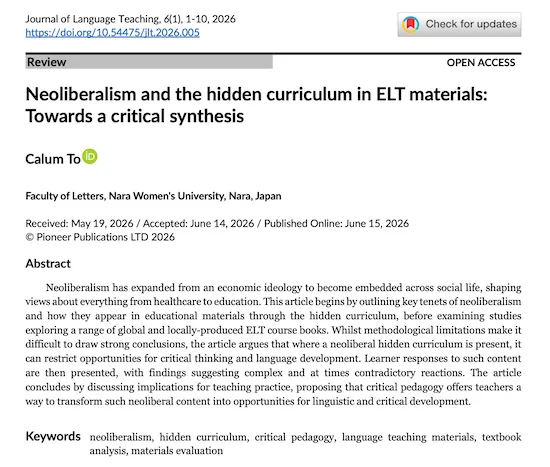
Neoliberalism and the hidden curriculum in ELT materials: Towards a critical synthesis
DOI:
https://doi.org/10.54475/jlt.2026.005Keywords:
neoliberalism, hidden curriculum, critical pedagogy, language teaching materials, textbook analysis, materials evaluationAbstract
Neoliberalism has expanded from an economic ideology to become embedded across social life, shaping views about everything from healthcare to education. This article begins by outlining key tenets of neoliberalism and how they appear in educational materials through the hidden curriculum, before examining studies exploring a range of global and locally-produced ELT course books. Whilst methodological limitations make it difficult to draw strong conclusions, the article argues that where a neoliberal hidden curriculum is present, it can restrict opportunities for critical thinking and language development. Learner responses to such content are then presented, with findings suggesting complex and at times contradictory reactions. The article concludes by discussing implications for teaching practice, proposing that critical pedagogy offers teachers a way to transform such neoliberal content into opportunities for linguistic and critical development.
References
Akbari, R. (2008). Postmethod discourse and practice. TESOL Quarterly, 42(4), 641–652. https://doi.org/10.1002/j.1545-7249.2008.tb00152.x DOI: https://doi.org/10.1002/j.1545-7249.2008.tb00152.x
Apple, M. W. (2019). Ideology and curriculum (4th ed). Routledge. DOI: https://doi.org/10.4324/9780429400384
Babaii, E. (2022). ELT as necessary evil: Resisting Western cultural dominance in foreign language policy in the context of Iran. Critical Inquiry in Language Studies, 19(4), 355–376. https://doi.org/10.1080/15427587.2022.2090363 DOI: https://doi.org/10.1080/15427587.2022.2090363
Babaii, E., & Sheikhi, M. (2018). Traces of neoliberalism in English teaching materials: A critical discourse analysis. Critical Discourse Studies, 15(3), 247–264. https://doi.org/10.1080/17405904.2017.1398671 DOI: https://doi.org/10.1080/17405904.2017.1398671
Barnawi, O. Z. (2019). Critical pedagogy in Saudi College EFL classrooms under the neoliberal economy. In M. E. López-Gopar (Ed.), International perspectives on critical pedagogies in ELT (pp. 39–58). Springer International Publishing. https://doi.org/10.1007/978-3-319-95621-3_3 DOI: https://doi.org/10.1007/978-3-319-95621-3_3
Barnawi, O. Z. (2023). EMI as a performative technology of acceleration in higher education contexts: academics and administrators’ perspectives. International Journal of Bilingual Education and Bilingualism, 26(10), 1170–1182. https://doi.org/10.1080/13670050.2021.1954385 DOI: https://doi.org/10.1080/13670050.2021.1954385
Barnawi, O. Z. (2022). Resisting and creating alternatives to neoliberalism in ELT: A case study of three transnational language teachers in Saudi Arabia. Critical Inquiry in Language Studies, 19(4), 377–399. https://doi.org/10.1080/15427587.2022.2102015 DOI: https://doi.org/10.1080/15427587.2022.2102015
Biesta, G. (2009). Good education in an age of measurement: On the need to reconnect with the question of purpose in education. Educational Assessment Evaluation and Accountability, 21. https://doi.org/10.1007/s11092-008-9064-9 DOI: https://doi.org/10.1007/s11092-008-9064-9
Bori, P. (2020). Neoliberal governmentality in global English textbooks. Classroom Discourse, 11(2), 149–163. https://doi.org/10.1080/19463014.2020.1755327 DOI: https://doi.org/10.1080/19463014.2020.1755327
Bori, P. (2021). Neoliberalism and global textbooks: A critical ethnography of English language classrooms in Serbia. Language, Culture and Curriculum, 34(2), 183–198. https://doi.org/10.1080/07908318.2020.1797082 DOI: https://doi.org/10.1080/07908318.2020.1797082
Bori, P., & Canale, G. (2022). Neoliberal foreign language education: The search for alternatives. Critical Inquiry in Language Studies, 19(4), 307–316. https://doi.org/10.1080/15427587.2022.2090362 DOI: https://doi.org/10.1080/15427587.2022.2090362
Boriboon, P. (2004, August 18). “We would rather talk about plaa raa than hamburgers”: Voices from low-proficient EFL learners in a rural Thai context. The 11th Sociocultural Theory and Second Language Learning Research Conference, University of Nijmegen, Netherlands.
Brenden, M., Bruch Jr, P. L., & Reynolds, T. (2024). Contesting literacies: Beyond the hidden curriculum of the Neoliberal Arts. Review of Education, Pedagogy, and Cultural Studies, 1–18. https://doi.org/10.1080/10714413.2024.2413220 DOI: https://doi.org/10.1080/10714413.2024.2413220
Brown, W. J. (2015). Undoing the demos: Neoliberalism’s stealth revolution. Zone Books. DOI: https://doi.org/10.2307/j.ctt17kk9p8
Brown, C. A. (2022). Symbolic Annihilation of Social Groups as Hidden Curriculum in Japanese ELT Materials. TESOL Quarterly, 56(2), 603–628. https://doi.org/10.1002/tesq.3073 DOI: https://doi.org/10.1002/tesq.3073
Brown, S. (2024). Beyond ELT: More than just teaching language. ELT Journal, 78(4), 498–519. https://doi.org/10.1093/elt/ccae038 DOI: https://doi.org/10.1093/elt/ccae038
Canh, L. V. (2022). Working towards centrally determined levels of proficiency: Uncovering the neoliberal standardization in the Vietnam-produced ELT textbooks. In A. Jalalian Daghigh, J. Mohd Jan, & S. Kaur (Eds.), Neoliberalization of English language policy in the Global South (Vol. 29, pp. 119–135). Springer International Publishing. https://doi.org/10.1007/978-3-030-92353-2_8 DOI: https://doi.org/10.1007/978-3-030-92353-2_8
Cohen, L., Manion, L., & Morrison, K. (2018). Research methods in education (8th ed.). Taylor & Francis Group. https://doi.org/10.4324/9781315456539 DOI: https://doi.org/10.4324/9781315456539
Copley, K. (2018). Neoliberalism and ELT coursebook content. Critical Inquiry in Language Studies, 15(1), 43–62. https://doi.org/10.1080/15427587.2017.1318664 DOI: https://doi.org/10.1080/15427587.2017.1318664
Cotton, D., Falvey, D., & Kent, S. (2010). Intermediate market leader business English coursebook (3rd ed.). Pearson Education Limited.
Çubukçu, Z. (2012). The effect of hidden curriculum on character education process of primary school students. Educational Science: Theory and Practice, 12, 1526–1534.
Dardot, P., & Laval, C. (2013). The new way of the world: On neoliberal society. Verso.
Fairclough, N. (2001). Language and power (2nd ed.). Routledge.
Foster, R. (2016). Freedom’s right: Critical social theory and the challenge of neoliberalism. Capital & Class, 1–20. https://doi.org/10.1177/0309816816678580 DOI: https://doi.org/10.1177/0309816816678580
Fraser, N. (2017). From progressive neoliberalism to Trump—and beyond. American Affairs Journal, 1(4), 46–64.
Freebody, P., & Luke, A. (1990). Literacies programs: Debates and demands in cultural context. Prospect: An Australian Journal of TESOL, 5(3), 7–16.
Freire, P. (1985). The politics of education: Culture, power, and liberation (D. P. Macedo, Trans.). Bergin & Garvey Publishers.
Goyal, R., & Rose, H. (2020). Stilettoed damsels in distress: The (un)changing depictions of gender in a business English textbook. Linguistics and Education, 58, 100820. https://doi.org/10.1016/j.linged.2020.100820 DOI: https://doi.org/10.1016/j.linged.2020.100820
Gray, J. (2010). The construction of English: Culture, consumerism and promotion in the ELT global coursebook. Palgrave Macmillan.
Gray, J. (2013). Neoliberalism, celebrity and ‘aspirational content’ in English language teaching textbooks for the global market. In D. Block, J. Gray, & M. Holborow, Neoliberalism and Applied Linguistics (pp. 91–118). Routledge. https://doi.org/10.4324/9780203128121-9 DOI: https://doi.org/10.4324/9780203128121-9
Gray, J. (2021). Addressing LGBTQ erasure through literature in the ELT classroom. ELT Journal, 75(2), 142–151. https://doi.org/10.1093/elt/ccaa079 DOI: https://doi.org/10.1093/elt/ccaa079
Gray, J. (2023). Curriculum and materials: Decolonization and inclusivity. In L. Wei, Z. Hua, & J. Simpson (Eds.), The Routledge handbook of applied linguistics (2nd ed.). Routledge. DOI: https://doi.org/10.4324/9781003082644-8
Gray, J., & Block, D. (2014). All middle class now? Evolving representations of the working class in the neoliberal era: The case of ELT textbooks. In N. Harwood (Ed.), English language teaching textbooks: Content, consumption, production (pp. 45–71). https://doi.org/10.1057/9781137276285_2 DOI: https://doi.org/10.1057/9781137276285_2
Gray, J., O’Regan, J. P., & Wallace, C. (2018). Education and the discourse of global neoliberalism. Language and Intercultural Communication, 18(5), 471–477. https://doi.org/10.1080/14708477.2018.1501842 DOI: https://doi.org/10.1080/14708477.2018.1501842
Hadley, G. (2014). Global textbooks in local contexts: An empirical investigation of effectiveness. In N. Harwood (Ed.), English language teaching textbooks (pp. 205–238). Palgrave Macmillan UK. https://doi.org/10.1057/9781137276285_7 DOI: https://doi.org/10.1057/9781137276285_7
Hadley, G., & Boon, A. (2022). Critical thinking. Routledge. https://doi.org/10.4324/9780429059865 DOI: https://doi.org/10.4324/9780429059865
Harvey, D. (2005). A brief history of neoliberalism. Oxford University Press. https://doi.org/10.1093/oso/9780199283262.003.0004 DOI: https://doi.org/10.1093/oso/9780199283262.001.0001
Harwood, N. (2014). Content, consumption, and production: Three levels of textbook research. In N. Harwood (Ed.), English Language Teaching Textbooks (pp. 1–41). Palgrave Macmillan UK. https://doi.org/10.1057/9781137276285_1 DOI: https://doi.org/10.1057/9781137276285_1
Harwood, N. (2022). Research in materials development. In J. Norton & H. Buchanan, The Routledge handbook of materials development for language teaching (1st ed., pp. 139–154). Routledge. https://doi.org/10.4324/b22783-13 DOI: https://doi.org/10.4324/b22783-13
He, J., & Buripakdi, A. (2022). Neoliberal values embedded in a Chinese college English textbook. Humanities, Arts and Social Sciences Studies, 22(1) 143–154. https://doi.org/10.14456/hasss.2022.14
Holborow, M. (2007). Language, ideology and neoliberalism. Journal of Language and Politics, 6, 51–73. https://doi.org/10.1075/jlp.6.1.05hol DOI: https://doi.org/10.1075/jlp.6.1.05hol
Jackson, P. W. (1968). Life in Classrooms. Teachers College Press.
Jalalian Daghigh, A., Kaur, S., & Mohd Jan, J. (2023). Neoliberal discourse in locally developed Malaysian English language textbooks: A comparison between the pre- and post-neoliberal eras. Globalisation, Societies and Education, 1–16. https://doi.org/10.1080/14767724.2023.2248012 DOI: https://doi.org/10.1080/14767724.2023.2248012
Jalalian Daghigh, A., Mohd Jan, J., & Kaur, S. (2022). Neoliberalization of English language policy in the Global South. Springer. https://doi.org/10.1007/978-3-030-92353-2 DOI: https://doi.org/10.1007/978-3-030-92353-2
Jenks, C. J. (2017). White Neoliberalism in ELT. In Race and Ethnicity in English Language Teaching (pp. 119–132). Multilingual Matters. DOI: https://doi.org/10.2307/jj.22730529.9
Jessop, B. (2012). Neoliberalism. In G. Ritzer (Ed.), The Wiley-Blackwell encyclopedia of globalization (Vol. 3, pp. 1513–1521). DOI: https://doi.org/10.1002/9780470670590.wbeog422
Joughlin, G. (2010). The hidden curriculum revisited: A critical review of research into the influence of summative assessment on learning. Assessment & Evaluation in Higher Education, 35(3), 335–345. https://doi.org/10.1080/02602930903221493 DOI: https://doi.org/10.1080/02602930903221493
Jeyaraj, J. J., & Harland, T. (2014). Transforming teaching and learning in ELT through critical pedagogy: An international study. Journal of Transformative Education, 12(4), 343–355. https://doi.org/10.1177/1541344614550042 DOI: https://doi.org/10.1177/1541344614550042
Kubota, R. (2011). Questioning linguistic instrumentalism: English, neoliberalism, and language tests in Japan. Linguistics and Education, 22(3), 248–260. https://doi.org/10.1016/j.linged.2011.02.002 DOI: https://doi.org/10.1016/j.linged.2011.02.002
Littlejohn, A. (2011). The analysis of language teaching materials: Inside the Trojan Horse. In B. Tomlinson (Ed.), Materials Development in Language Teaching (2nd ed., pp. 179–211). Cambridge University Press. https://doi.org/10.1017/9781139042789.011 DOI: https://doi.org/10.1017/9781139042789.011
Littlejohn, A. (2012). Language teaching materials and the (very) big picture. Electronic Journal of Foreign Language Teaching, 9(1), 283–297.
Littlejohn, A. (2022). Dialogue and neoliberalism: Alternative conceptions for the second language classroom. Critical Inquiry in Language Studies, 19(4), 317–335. https://doi.org/10.1080/15427587.2022.2147071 DOI: https://doi.org/10.1080/15427587.2022.2147071
Milton, J., & Alexiou, T. (2020). Vocabulary Size Assessment: Assessing the Vocabulary Needs of Learners in Relation to Their CEFR Goals (pp. 9–27). https://doi.org/10.1007/978-3-030-48663-1_2 DOI: https://doi.org/10.1007/978-3-030-48663-1_2
Nation, I.S.P. (2017). The BNC/COCA Level 9 word family lists (Version 1.0.0) [Data file]. Available from http://www.victoria.ac.nz/lals/staff/paul-nation.aspx
Nation, I. S. P. (2022). Learning vocabulary in another language (3rd edn). Cambridge University Press. https://doi.org/10.1017/9781009093873 DOI: https://doi.org/10.1017/9781009093873
Nowell, L. S., Norris, J. M., White, D. E., & Moules, N. J. (2017). Thematic analysis: Striving to meet the trustworthiness criteria. International Journal of Qualitative Methods, 16(1), 1609406917733847. https://doi.org/10.1177/1609406917733847 DOI: https://doi.org/10.1177/1609406917733847
Nunan, D. (2003). Go for it!. Cengage Learning; People’s Education Press
O’Neill, R. (1970). English in Situations. Oxford University Press.
Ordem, E. (2023). Deconstructing neoliberalism through critical reflection, participatory and emancipatory action research in second language learning and teaching. Multicultural Learning and Teaching, 18(1), 125–142. https://doi.org/10.1515/mlt-2020-0004 DOI: https://doi.org/10.1515/mlt-2020-0004
Ortaçtepe Hart, D. (2023). Social justice and the language classroom reflection, action, and transformation. Edinburgh University Press.
Pennycook, A. (2019). From translanguaging to translingual activism. In D. Macedo (Ed.), Decolonizing Foreign Language Education (1st ed., pp. 169–185). Routledge. https://doi.org/10.4324/9780429453113-7 DOI: https://doi.org/10.4324/9780429453113-7
Pennycook, A. (2021). Critical applied linguistics: A critical re-introduction (2nd ed.). Routledge. https://doi.org/10.4324/9781003090571 DOI: https://doi.org/10.4324/9781003090571
Redston, C., & Cunningham, G. (2012). Face2Face: Pre-intermediate (2nd ed.). Cambridge University Press.
Ritzer, G. (2020). The McDonaldization of society: Into the digital age (10th ed.). Sage.
Saltman, K. J. (2020). Opposition to curriculum structured by neoliberal globalization. In Oxford Research Encyclopedia of Education. https://doi.org/10.1093/acrefore/9780190264093.013.1156 DOI: https://doi.org/10.1093/acrefore/9780190264093.013.1156
Sayer, P. (2019). The hidden curriculum of work in English language education: Neoliberalism and early English programs in public schooling. AILA Review, 32, 36–63. https://doi.org/10.1075/aila.00020.say DOI: https://doi.org/10.1075/aila.00020.say
Selvi, A. F. (2019). Qualitative content analysis. In J. McKinley & H. Rose (Eds.), The Routledge handbook of research methods in applied linguistics (pp. 440–454). Routledge. DOI: https://doi.org/10.4324/9780367824471-37
Shah, W. A., Pardesi, H. Y., & Memon, T. (2024). Neoliberalizing subjects through global ELT programs. TESOL Quarterly, 58(2), 693–725. https://doi.org/10.1002/tesq.3242 DOI: https://doi.org/10.1002/tesq.3242
Sleeter, C. E., & Grant, C. A. (2017). Race, class, gender, and disability in current textbooks. In M. W. Apple & L. K. Christian-Smith (Eds.), The Politics of the Textbook (1st ed., pp. 78–110). Routledge. https://doi.org/10.4324/9781315021089-5 DOI: https://doi.org/10.4324/9781315021089-5
Soars, J. and L. Soars (1986) Headway Intermediate. Oxford University Press.
Soars, L. and J. Soars (1996) New Headway Intermediate. Oxford University Press.
Soars, L. and J. Soars (2009) New Headway Intermediate. Oxford University Press.
Soars, J., & Soars, L. (2014). New Headway: Upper-intermediate (4th ed.). Oxford University Press.
Soars, L., & Soars, J. (2016). American Headway (3rd ed.). Oxford University Press.
Taylor, C. (1994). The politics of recognition. In A. Gutmann (Ed.), Multiculturalism: Examining the politics of recognition (pp. 25–74). Princeton University Press. DOI: https://doi.org/10.2307/j.ctt7snkj.6
Taylore-Knowles, J., & Taylore-Knowles, S. (2014). Open mind. Macmillan.
Tomlinson, B. (2020). Is materials development progressing? Language Teaching Research Quarterly, 15, 1–20. https://doi.org/10.32038/ltrq.2020.15.01 DOI: https://doi.org/10.32038/ltrq.2020.15.01
Tor, D. (2015). Exploring physical environment as hidden curriculum in higher education: A grounded theory study. [Unpublished doctoral dissertation]. Middle East Technical University.
Tyson, H., & Woodward, A. (1989). Why students aren’t learning very much from textbooks. Educational Leadership, 47(3), 14–17.
Urciuoli, B. (2008). Skills and selves in the new workplace. American Ethnologist, 35(2), 211–228. https://doi.org/10.1111/j.1548-1425.2008.00031.x DOI: https://doi.org/10.1111/j.1548-1425.2008.00031.x
van Dijk, T. A. (1981). Episodes as units of discourse analysis. In D. Tannen (Ed.), Analyzing discourse: Text and talk (pp. 177–195). Georgetown University Press.
Xiong, T., & Yuan, Z. (2018). “It was because I could speak English that I got the job”: Neoliberal discourse in a Chinese English textbook series. Journal of Language, Identity & Education, 17(2), 103–117. https://doi.org/10.1080/15348458.2017.1407655 DOI: https://doi.org/10.1080/15348458.2017.1407655
Zheng, S. (Ed.). (2017). New Horizon College English: Listening, Speaking and Viewing 2 (3rd edition). Foreign Language Teaching and Researching Press.
Downloads
Published
Issue
Section
License
Copyright (c) 2026 Journal of Language Teaching

This work is licensed under a Creative Commons Attribution 4.0 International License.
How to Cite