
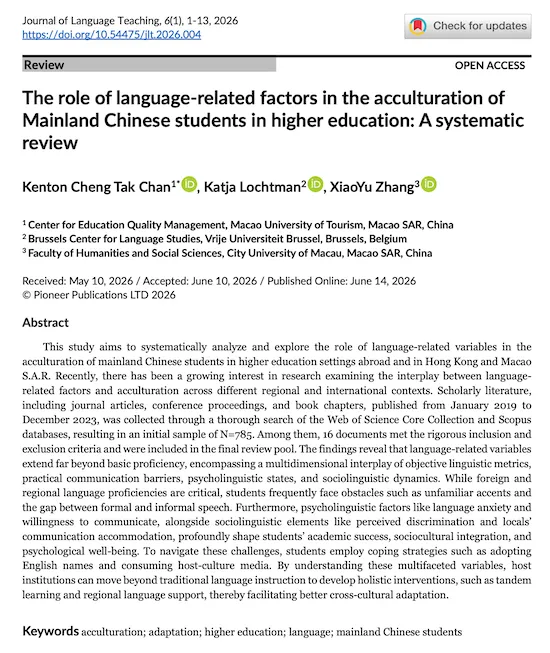
The role of language-related factors in the acculturation of Mainland Chinese students in higher education: A systematic review
DOI:
https://doi.org/10.54475/jlt.2026.004Keywords:
acculturation, adaptation, higher education, language, mainland Chinese studentsAbstract
This study aims to systematically analyze and explore the role of language-related variables in the acculturation of mainland Chinese students in higher education settings abroad and in Hong Kong and Macao S.A.R. Recently, there has been a growing interest in research examining the interplay between language-related factors and acculturation across different regional and international contexts. Scholarly literature, including journal articles, conference proceedings, and book chapters, published from January 2019 to December 2023, was collected through a thorough search of the Web of Science Core Collection and Scopus databases, resulting in an initial sample of N=785. Among them, 16 documents met the rigorous inclusion and exclusion criteria and were included in the final review pool. The findings reveal that language-related variables extend far beyond basic proficiency, encompassing a multidimensional interplay of objective linguistic metrics, practical communication barriers, psycholinguistic states, and sociolinguistic dynamics. While foreign and regional language proficiencies are critical, students frequently face obstacles such as unfamiliar accents and the gap between formal and informal speech. Furthermore, psycholinguistic factors like language anxiety and willingness to communicate, alongside sociolinguistic elements like perceived discrimination and locals’ communication accommodation, profoundly shape students’ academic success, sociocultural integration, and psychological well-being. To navigate these challenges, students employ coping strategies such as adopting English names and consuming host-culture media. By understanding these multifaceted variables, host institutions can move beyond traditional language instruction to develop holistic interventions, such as tandem learning and regional language support, thereby facilitating better cross-cultural adaptation.
References
Almazova, N., Rubtsova, A., Eremin, Y., Kats, N., & Baeva, I. (2020). Tandem language learning as a tool for international students sociocultural adaptation. In Lecture notes in networks and systems (pp. 174–187). https://doi.org/10.1007/978-3-030-47415-7_19 DOI: https://doi.org/10.1007/978-3-030-47415-7_19
Aoyama, T., & Takahashi, T. (2020). International students’ willingness to communicate in English as a second language: The effects of L2 self-confidence, acculturation, and motivational types. Journal of International Students, 10(3), 703–723. https://doi.org/10.32674/jis.v10i3.730 DOI: https://doi.org/10.32674/jis.v10i3.730
Berry, J. W. (2005). Acculturation: Living successfully in two cultures. International journal of intercultural relations, 29(6), 697–712. https://doi.org/10.1016/j.ijintrel.2005.07.013 DOI: https://doi.org/10.1016/j.ijintrel.2005.07.013
Berry, J. W., & Hou, F. (2017). Acculturation, discrimination and wellbeing among second generation of immigrants in Canada. International Journal of Intercultural Relations, 61, 29–39. https://doi.org/10.1016/j.ijintrel.2017.08.003 DOI: https://doi.org/10.1016/j.ijintrel.2017.08.003
Cao, C., & Meng, Q. (2019). Mapping the paths from language proficiency to adaptation for Chinese students in a non-English speaking country: An integrative model of mediation. Current Psychology, 38(6), 1564–1575. https://doi.org/10.1007/s12144-017-9708-3 DOI: https://doi.org/10.1007/s12144-017-9708-3
Ding, X. (2016). Exploring the experiences of international students in China. Journal of Studies in International Education, 20(4), 319–338. https://doi.org/10.1177/1028315316647164 DOI: https://doi.org/10.1177/1028315316647164
Government of the Macao SAR Education and Youth Development Bureau. (2023). An overview of educational statistics 2023. Government of the Macao Special Administrative Region. https://mirror1.dsedj.gov.mo/dsedj/stati/2022/e/full_text_e.pdf
Gullahorn, J. T., & Gullahorn, J. E. (1963). An extension of the U‐Curve Hypothesis 1. Journal of social issues, 19(3), 33–47. https://doi.org/10.1111/j.1540-4560.1963.tb00447.x DOI: https://doi.org/10.1111/j.1540-4560.1963.tb00447.x
Hendrickson, B., Rosen, D., & Aune, R. K. (2011). An analysis of friendship networks, social connectedness, homesickness, and satisfaction levels of international students. International Journal of Intercultural Relations, 35(3), 281-295. https://doi.org/10.1016/j.ijintrel.2010.08.001 DOI: https://doi.org/10.1016/j.ijintrel.2010.08.001
Hofhuis, J., Hanke, K., & Rutten, T. (2019). Social network sites and acculturation of international Sojourners in the Netherlands: The mediating role of psychological alienation and online social support. International Journal of Intercultural Relations, 69, 120–130. https://doi.org/10.1016/j.ijintrel.2019.02.002 DOI: https://doi.org/10.1016/j.ijintrel.2019.02.002
Hummel, K. M. (2021). Introducing second language acquisition: Perspectives and practices (2nd ed.). Wiley Blackwell.
Jia, F., & Koku, E. F. (2019). Music listening and cultural adaptation: How different languages of songs affect Chinese international students’ uses of music and cultural adaptation in the United States. Journal of International and Intercultural Communication, 13(4), 291–308. https://doi.org/10.1080/17513057.2019.1618893 DOI: https://doi.org/10.1080/17513057.2019.1618893
Jiang, D., Dahl, B., & Bøgelund, P. (2021). Changes of adaptability strategies to Problem-Based Learning: A longitudinal study of first-year Chinese engineering graduate students. In H.-U. Heiß, H.-M. Järvinen, A. Mayer, & A. Schulz (Eds.), Blended Learning in Engineering Education: challenging, enlightening – and lasting? Proceedings SEFI 49th Annual Conference (pp. 248-257). SEFI: European Association for Engineering Education. https://www.sefi.be/wp-content/uploads/2021/12/SEFI49th-Proceedings-final.pdf
Jiang, L., & Altinyelken, H. K. (2022). Understanding social integration of Chinese students in the Netherlands: The role of friendships. Journal of Intercultural Communication Research, 51(2), 191–207. https://doi.org/10.1080/17475759.2021.1877178 DOI: https://doi.org/10.1080/17475759.2021.1877178
Kim, Y. Y. (2001). Becoming intercultural: An integrative theory of communication and cross-cultural adaptation. Sage. DOI: https://doi.org/10.4135/9781452233253
Lai, H., Wang, D., & Ou, X. (2023). Cross-cultural adaptation of Chinese students in the United States: Acculturation strategies, sociocultural, psychological, and academic adaptation. Frontiers in Psychology, 13. https://doi.org/10.3389/fpsyg.2022.924561 DOI: https://doi.org/10.3389/fpsyg.2022.924561
Li, H. (2019). Academic integration of Chinese students in Finland and Germany: a comparative perspective. Frontiers of Education in China, 14(2), 234–256. https://doi.org/10.1007/s11516-019-0012-x DOI: https://doi.org/10.1007/s11516-019-0012-x
Liu, G., Li, W., & Zhang, Y. (2022). Tracing Chinese international students’ psychological and academic adjustments in uncertain times: An exploratory case study in the United Kingdom. Frontiers in Psychology, 13, 942227. https://doi.org/10.3389/fpsyg.2022.942227 DOI: https://doi.org/10.3389/fpsyg.2022.942227
Lou, N. M. (2021). Acculturation in a postcolonial context: Language, identity, cultural adaptation, and academic achievement of Macao students in Mainland China. International Journal of Intercultural Relations, 85, 213–225. https://doi.org/10.1016/j.ijintrel.2021.10.004 DOI: https://doi.org/10.1016/j.ijintrel.2021.10.004
Lysgaard, S. (1955). Adjustment in a foreign society: Norwegian Fulbright grantees visiting the United States. International Social Science Bulletin, 7, 45-51.
Ma, A., & Holford, J. (2024). Mainland Chinese students in Hong Kong: Coping with the Socio-Political Challenges of 2017 to 2020. Journal of Studies in International Education, 28(4), 588–605. https://doi.org/10.1177/10283153231187142 DOI: https://doi.org/10.1177/10283153231187142
MacIntyre, P. D., & Wang, L. (2021). Willingness to communicate in the L2 about meaningful photos: Application of the pyramid model of WTC. Language Teaching Research, 25(6), 878-898. https://doi.org/10.1177/13621688211004645 DOI: https://doi.org/10.1177/13621688211004645
Matras, Y. (2020). Language contact. Cambridge University Press. DOI: https://doi.org/10.1017/9781108333955
Miao, L., & Wang, H. Y. (2024, March 16). China still leading source of foreign students. China Daily. https://www.chinadaily.com.cn/a/202403/16/WS65f4e78ba31082fc043bcf71.html
Page, M. J., McKenzie, J. E., Bossuyt, P. M., Boutron, I., Hoffmann, T. C., Mulrow, C. D., Shamseer, L., Tetzlaff, J. M., Akl, E. A., Brennan, S. E., Chou, R., Glanville, J., Grimshaw, J. M., Hróbjartsson, A., Lalu, M. M., Li, T., Loder, E. W., Mayo-Wilson, E., McDonald, S., . . . Moher, D. (2021). The PRISMA 2020 statement: an updated guideline for reporting systematic reviews. BMJ, 372, n71. https://doi.org/10.1136/bmj.n71 DOI: https://doi.org/10.1136/bmj.n71
Qian, J., & Yu, J. (2023). Effects of Chinese language learning anxiety on the mental health of international students in China: The chain mediating effect of campus adaptation and academic resilience. Psychology Research and Behavior Management, 16, 2201–2211. https://doi.org/10.2147/prbm.s414837 DOI: https://doi.org/10.2147/PRBM.S414837
Rudmin, F., Wang, B., & de Castro, J. (2017). 5 acculturation research critiques. In The Oxford handbook of acculturation and health (pp. 75–96). https://doi.org/10.1093/oxfordhb/9780190215217.013.4 DOI: https://doi.org/10.1093/oxfordhb/9780190215217.013.4
Sam, D. L., & Berry, J. W. (2010). Acculturation: When individuals and groups of different cultural backgrounds meet. Perspectives on Psychological Science, 5(4), 472–481. https://doi.org/10.1177/1745691610373075 DOI: https://doi.org/10.1177/1745691610373075
South China Morning Post. (2024). University of Hong Kong admits 50% more students from outside city this year. https://www.scmp.com/news/hong-kong/education/article/3281921/university-hong-kong-admits-50-more-students-outside-city-year
Sun, X., Hall, G. C. N., DeGarmo, D. S., Chain, J., & Fong, M. C. (2021). A longitudinal investigation of discrimination and mental health in Chinese international students: The role of Social Connectedness. Journal of Cross-Cultural Psychology, 52(1), 61–77. https://doi.org/10.1177/0022022120979625 DOI: https://doi.org/10.1177/0022022120979625
Tian, M., & Lu, G. (2018). Intercultural learning, adaptation, and personal growth: A longitudinal investigation of international student experiences in China. Frontiers of Education in China, 13(1), 56–92. https://doi.org/10.1007/s11516-018-0003-3 DOI: https://doi.org/10.1007/s11516-018-0003-3
UNESCO. (2024). Outbound internationally mobile students by host region. http://data.uis.unesco.org/index.aspx?queryid=3807
van Niejenhuis, C., Otten, S., & Flache, A. (2018). Sojourners’ second language learning and integration. The moderating effect of multicultural personality traits. International Journal of Intercultural Relations, 63, 68–79. https://doi.org/10.1016/j.ijintrel.2018.01.001 DOI: https://doi.org/10.1016/j.ijintrel.2018.01.001
Ward, C. (2001). The A, B, Cs of acculturation. In Matsumoto, D. (Ed.), The handbook of culture and psychology (pp. 411–445). Oxford University Press.
Wilczewski, M., & Alon, I. (2023). Language and communication in international students’ adaptation: a bibliometric and content analysis review. Higher education, 85(6), 1235–1256. https://doi.org/10.1007/s10734-022-00888-8 DOI: https://doi.org/10.1007/s10734-022-00888-8
Wilson, S. R., Billotte Verhoff, C., Yue, C. A., Dorrance Hall, E., & McNallie, J. (2020). Chinese international undergraduate students’ English language ability, advice from domestic and international friends, and psychosocial adjustment to college. Journal of Language and Social Psychology, 39(2), 260-270. https://doi.org/10.1177/0261927X19872791 DOI: https://doi.org/10.1177/0261927X19872791
Wu, H., Garza, E., & Guzman, N. (2015). International student’s challenge and adjustment to college. Education Research International, 2015, 1–9. https://doi.org/10.1155/2015/202753 DOI: https://doi.org/10.1155/2015/202753
Wu, X. I., Occhipinti, S., & Watson, B. (2025). Mainland Chinese students’ psychological adaptation to Hong Kong: an intergroup communication perspective. Journal of Multilingual and Multicultural Development, 46(8), 2342–2357. https://doi.org/10.1080/01434632.2023.2287045 DOI: https://doi.org/10.1080/01434632.2023.2287045
Wu, X. I., Watson, B. M., & Baker, S. C. (2024). The role of language use and communication in Mainland Chinese students’ cross-cultural adaptation to Hong Kong: a qualitative investigative study. Language and Intercultural Communication, 24(1), 20–34. https://doi.org/10.1080/14708477.2023.2250748 DOI: https://doi.org/10.1080/14708477.2023.2250748
Yu, B., Mak, A. S., & Bodycott, P. (2019). Psychological and academic adaptation of mainland Chinese students in Hong Kong universities. Studies in Higher Education, 46(8), 1552–1564. https://doi.org/10.1080/03075079.2019.1693991 DOI: https://doi.org/10.1080/03075079.2019.1693991
Zhai, X., & Razali, A. B. (2022). International Chinese Postgraduate Students’ adaptation Strategies for Oral English Communication Practices in Malaysian higher education institutions. Education Research International, 2022, 1–11. https://doi.org/10.1155/2022/6439726 DOI: https://doi.org/10.1155/2022/6439726
Zhang, Y. S. D., & Noels, K. A. (2024). ‘Call me “Katy” instead of “Yueyun”’: English names among Chinese international students in Canada. Journal of Multilingual and Multicultural Development, 45(8), 3379–3393. https://doi.org/10.1080/01434632.2022.2098304 DOI: https://doi.org/10.1080/01434632.2022.2098304
Downloads
Published
Issue
Section
License
Copyright (c) 2026 Journal of Language Teaching

This work is licensed under a Creative Commons Attribution 4.0 International License.
How to Cite